


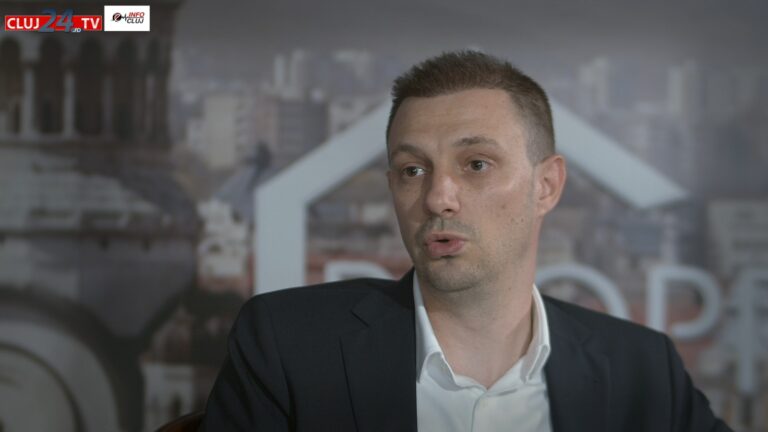
Cluj 24 together with InfoCluj.eu launched the online TV show "Owner in Cluj", the guest of Friday's edition by Eugen Olariu being Alin Danci, entrepreneur in the field of job placement.
-
Cluj 24 together with InfoCluj.eu launched the online TV show "Owner in Cluj", the guest of Friday's edition by Eugen Olariu being Alin Danci, entrepreneur in the field of job placement.
________________________________________
- Cluj is an El Dorado in terms of financial placements in the real estate market.More and more Romanians are investing in buying real estate, apartments, houses and land in the Cluj metropolitan area. We will not discuss this in this show but I would like to ask you how attractive Cluj is in terms of the job market?
A.D: Although I am also active in the real estate area, I have opened a partnership in this area as well, I will not go into this subject very much. In terms of labour force, Cluj has a very great need. At least lately the demand for workers, here I mean workers from Asia, is very high. Especially in the construction area, as well as in the HORECA and other services.
- You say that there are people from Asia who want to work in Cluj but there are Romanians who want to work in Cluj? In the construction field there is a very high demand but it seems that Romanians are not satisfied with the salary offered in this field even though it is a decent salary.
A.D: They are willing to come and work. Indeed, life in Cluj is more expensive in the first place. Secondly, they are tempted to go to western countries where the salaries are much higher. The standard of living is probably higher, even if lately we have heard that we compare ourselves to Barcelona or Cluj-Napoca compares itself to Barcelona.
- Probably from the perspective of the tourists who visit us because if we talk about infrastructure we can't compare ourselves with all due respect to the mayor who made this statement that we compare ourselves with Munich or Barcelona.
A.D: Probably from the perspective of the quality of the tourists not the number of tourists. We can certainly compare ourselves, there are certain indicators we compare ourselves to, but let's be realistic.
- We can compare ourselves, you said earlier, on certain indicators, from the perspective of pollution, as Barcelona is a rather polluted city.
A.D: Here we can have a discussion, we can do a whole programme on this topic.
- We see a lot of people coming from Asia to work in Romania. Cluj has the capacity to absorb these people coming from Bangaldesh, Vietnam, Sri Lanka.
A.D: From the point of view of the population and the employer, Cluj is a tolerant city. We have a multicultural community. We have not had any problems with workers adapting. The market demands more and more, the shortage of employees is increasing as infrastructure projects increase in number.Unskilled and skilled workers
- Why these people don't go to work in closer areas. From Vietnam for example to work in Singapore or Indonesia. What are the reasons that bring them to our country?
A.D: The construction phase of cities, of metropolises has been reduced and they are now going to other countries and this is one of the big advantages because many of the workers who come to Romania come with a specialisation. They have worked in countries in the Near East or in neighbouring countries.
Somehow they are prepared for work abroad. The biggest demand is for unskilled workers, but there is a growing demand for skilled and highly skilled trades. Demand in Romania is also moving towards other categories of employees.
- Are these employees disciplined in terms of seriousness at work?
A.D: Yes. They are disciplined. They come here with the idea of supporting their families and making a future for themselves in their own countries. They don't think about staying in Romania to make a future here.
- We can say that these people come for a short period of time, a year, two years or depending on the investment projects.
A.D: In principle, contracts are concluded for two years, but the period can be adapted depending on the employer's projects.
- How does the selection process work for these people who come to work for us?
A.D: It differs a lot depending on the specialisation. For unskilled people or unskilled workers it is a simpler process. It doesn't require a long selection process. It can be up to a few hours usually. We have the databases. We communicate very well with partners in the countries of origin.
The principle: we identify the employer's need for labour. Depending on that, it is determined whether a work sample or an interview is needed. Once we have a very clear job description, we prepare the recruitment process with the partner in the country they want or often we select several countries and depending on what they offer us, what we can identify, we then determine which candidates we will interview.
- Before we determine these candidates that we interview, we identify in the first phase the companies in Romania and in the Cluj area that need this workforce and are willing to financially support these contracts for at least 2 years.
A.D:Absolutely. Usually companies ask us and we don't go to them with an initial offer. Indeed there have been cases where we have gone to companies that we knew needed labour and were not aware of the possibility of recruiting workers from Asia. The biggest range of clients they identify to us.Selection lasts
- After that interview, how does the 1800s proceed? Are they put on the plane? How is the work visa obtained?
A.D: It's not that simple. Basically the selection and recruitment process lasts, as I mentioned above, depending on the qualification. If we choose an unskilled worker, as I said, it can take up to a few hours. If we go for highly skilled, engineering or even IT it can take up to a month to identify future employees.
Afterwards we decide with the employer which will be the work sample or the interview depending on the specialty. We have the possibility to go to the country of origin to attend the work samples to be as well adapted as possible to the client's needs.
That is, we even try to prepare a worksite in the country of origin so that they can actually see the degree of knowledge in the field and the degree of adaptability to the employer's needs.
After the selection we obtain the documents of the future employee through our partners in the country of origin and in Romania, in order to apply for the employment permit, from the employer, a series of documents. It is important that the employer does not have debts to the state and has as object of activity the field for which the future employee will be hired on the job.
The employment notice takes up to 30-60 days, depending on the county and the number of requests from the immigration offices. After obtaining the employment permit, the long-stay visa for employment in Romania will be applied for at the embassy of the country of origin or one of the consulates, for countries that have consular offices and for countries that do not have consular offices, in neighbouring countries.
This is what I am telling you and I have referred to it because it takes a long time, it differs a lot in the time it takes to obtain a long-stay visa depending on the country of origin.
- The period for obtaining a visa lasts. How digitalized is Romania in this respect?
A.D: I can say that I have noticed an evolution, at least for obtaining the employment permit. All the documents in the first phase are submitted online, a preliminary analysis is done and then they are physically submitted to the immigration office.
I can say that from this perspective we are digitized. I couldn't tell you how digitized the visa process is because that's what we do with our partners and I told you it differs depending on the country of origin and depending on the embassy. But I think and I have also felt that I and other colleagues in the field would still need a supplement of immigration service employees at least in the counties where... in university counties such as Cluj, Timisoara Iasi, Ilfov, Bucharest where we have a large flow of foreign students.
Besides that, being very economically developed counties, we also have a large flow of workers from Asia. Then the pressure on immigration services increases a lot and they cannot process documents and the time increases.
- Which are the counties where there is the highest demand for such workers? You mentioned earlier that there are those counties where there is a lot of work on the infrastructure side.
A.D: The counties where we have an increased economic development, I can say that we are basically addressing Transylvania but we have also had clients from other regions.
- If you were to make a top of the counties, where would Cluj be in terms of the need for labour from abroad.
A.D: From the point of view of our clients, the first place in terms of demand is after Bucharest - Ilfov. I don't have the complete figures but definitely in competition with Timis and Iasi.
• Din ce zone vin acesti muncitori? Daca vin doar dn Vietnam doar din Sri Lanka?HORECA workers
A.D: We have partnerships in Vietnam, India in Bangladesh, Nepal, Sri Lanka and more recently in Pakistan. We have had contacts but we have not worked with the Philippines or Indonesia.
The main countries from which we have recruited workers have been Vietnam, India and Bangladesh. Nepal less so and Sri Lanka but depending on demand...
For example Sri Lankan workers are suitable for HORECA, in the kitchen and service part. They speak English so ... being a country with a fairly developed tourism sector they have had experience although they have worked in other Middle Eastern countries also in HORECA or predominantly in HORECA but not necessarily. I mean there are other industries that we recruit for.
- Have you had discussions with these people about how the pandemic has affected them, the two years of the pandemic?
A.D: We haven't had any discussions but we did feel that some workers were relocated. Clearly there was a problem. It wasn't felt so much because they were subsidised and the big hotels also had budgets that supported this technical unemployment, this shock let's call it.
- Who pays the taxes? The employer, the worker, the state where these workers come from?
A.D: We are talking about several taxes here. First of all we have the fee for obtaining the documents until the worker arrives in Romania that the employer pays.
Then after the foreign worker is hired, he pays the same taxes as the Romanian worker and has the possibility to recover them, there is a procedure where he can recover the taxes if he does not work in Romania anymore.
- I refer to commissions. You gave an interview a year ago in which you mentioned that companies in Vietnam or Bangladesh charge a monthly commission to these employees.
A.D: From Vietnam it was at that time but there are several types or procedures. There are procedures where the worker pays a monthly fee out of the salary or actually pays a fee to the agency to find an employer.
Lately, this is the practice, to pay a one-time recruitment fee by the worker. We are not talking about a large fee because the demand is also quite high and then it is compensated.150 dollars salary in Vietnam
- How many months can they support their family in Vietnam for example.
A.D: If we think that in Vietnam the average salary is 150 dollars a month and in Romania an unskilled worker starts from 500 dollars a month...
- We can say that for a month worked in Romania almost half a year supports his family at home.
A.D: We can do this calculation or we can think that the employee does not have any other expenses in Romania with meals and accommodation that the employer offers. Also, depending on the agreement the employee makes with the employer, the employer may also offer transport to the home country on leave.
- Can we compare this kind of intermediation with what we were doing 10-15 years ago with the placement of Romanian workers abroad, to the UK, to the United States or Italy, Spain?
A.D: Yes we could. I haven't had that experience but I tend to believe that Romanians have worked in tougher conditions in Western countries than the workers we have recruited are working now.
- Earlier you mentioned the workforce, skilled in the IT field in engineering. Do you have a statistic on the percentage of staff coming to Romania in this respect?
A.D: This is quite a broad discussion at least with IT staff. I couldn't give you figures and I don't have percentages for that. There is certainly demand and supply for the IT area. We have partnerships and even want to set up outsourced offices for IT workers in India or Pakistan. I mean they can work remotely on projects or as outsourced partners for companies in Romania.
•
A change to the Tax Code is being discussed from next year. Among the measures officials want to impose is a provision that would phase out tax breaks. Can we imagine that the lack of money in the budget will mean that IT-workers will be forced to pay taxes?
A.D: I know there have been discussions and debates. There will certainly be a need for further analysis. I don't know if the blunt or radical decisions are better. You have to take into account that the IT sector is one that supports the economy, at least in Cluj county the IT sector has a rather large footprint.
- Many of my colleagues say that IT-ists have raised the price of coffee in the centre.
A.D: There may be a discussion in real estate but I haven't seen any concrete studies on the sector.Anger and helplessness over deforestation
- You said last year that deforestation is nothing but an attack on national security. As a fisherman on mountain rivers, how do you see deforestation in the mountain area of Cluj county? You have been subprefect and have encountered problems including flooding in Cluj county.
A.D: Fly fisherman or at least I try to be I don't know how good I am. I haven't changed my mind, but I am referring to national security when I think how much forests have been destroyed in Cluj county and in neighbouring counties. We're talking about the Apuseni Mountains. Every time I go fishing in the Maguri Racatau area, I look at the mountain tops and see them more and more bare and... I don't know... I have such a feeling of anger and helplessness at the same time when I think that this phenomenon is widespread and I think it is possible to be stopped only by the active contribution of the civil society and of course of the authorities.
- But we have had cases where civil society, people who have reported illegal wood shipments have been threatened or even beaten. Do you think the legislation in this area should be changed? The penalties should be much more severe.
A.D: I think that the penalties are drastic and I think that we have laws in this area, we just need to enforce them and those who enforce them need to be more tough in this area.
- How do you comment on the fact that some 7 hectares of forest have been taken out of the forestry sector in the Poieni area, but the lots have been divided in two so that there is no need for a permit from Bucharest. The permission was obtained from Cluj for the extension of the stone quarrying area in the Grandemar quarry.
A.D: I don't know the subject very well but surely those who have an interest in the area will always find legislative artifices to circumvent the law.
- Just like in accounting. We have a tax code, we have legislation, but there will always be an accountant who will find a trick to avoid paying certain taxes. In other words, there is talk of green energy, because we can say that we are facing an energy crisis, we see what the prices are for electricity and gas. I would like to ask you how you see if Romania, we have to admit that Cluj county has potential, in terms of hydro energy, which is considered a green energy. At the same time, setting up mini hydro power plants would lead to environmental degradation.
Without micro hydropower
A.D: Your question is about whether in the current geopolitical context we should go back to building micro-hydropower plants. Absolutely not. At least I think that the benefits or the current produced by those micro hydropower plants compared to the destruction they would do once built would not be justified.
They create those or so to say destroy the ecosystem in those areas. I've seen a lot of studies from Austria where they've given up on micro hydro and in the US they've really given up and they're trying to rebuild that ecosystem which has been irreparably destroyed so it can never go back to what it was. Surely alternative sources of green energy will be found but not at any cost.
A.Q: Speaking of costs, the Offshore Law was voted. Romania will receive 5 billion lei annually in royalties for the exploitation of gas from the Black Sea. Do you think this is a good enough amount for the Romanian state? 1 billion euro.
A.D: To be able to give my opinion I would have to know the field. I don't know the field and I don't know the economic impact it would have. From what I have read, Romania will have a right of first refusal to acquire those hydrocarbons. I don't know if the price will be a price related to the stock exchange or one agreed between the parties.
- You also mentioned the real estate market. It came to 1800 euros per square meter of residential space. On average. We also have 4000 euros on Avram Iancu Street or on Paster at 3500 plus VAT. How do you find these prices compared to the income of the Romans?
Inflated real estate prices
A.D: When I think about the price of apartments and houses, I also think about the yield that the future owner or landlord gets from the rent. I think it's a ... I'm going to say unacademically ... an inflated one.
- Who inflates these prices? Real estate agents, landlords, developers?
A.D: I wouldn't say estate agents. There are certainly several contributing factors. There is a huge demand. They are not building or the number of buildings is not in relation to the demand and then prices rise speculatively. I believe that a good return on an apartment or space is between 10 and 15 years. That space should be covered, paid for by rent.
